Introduction
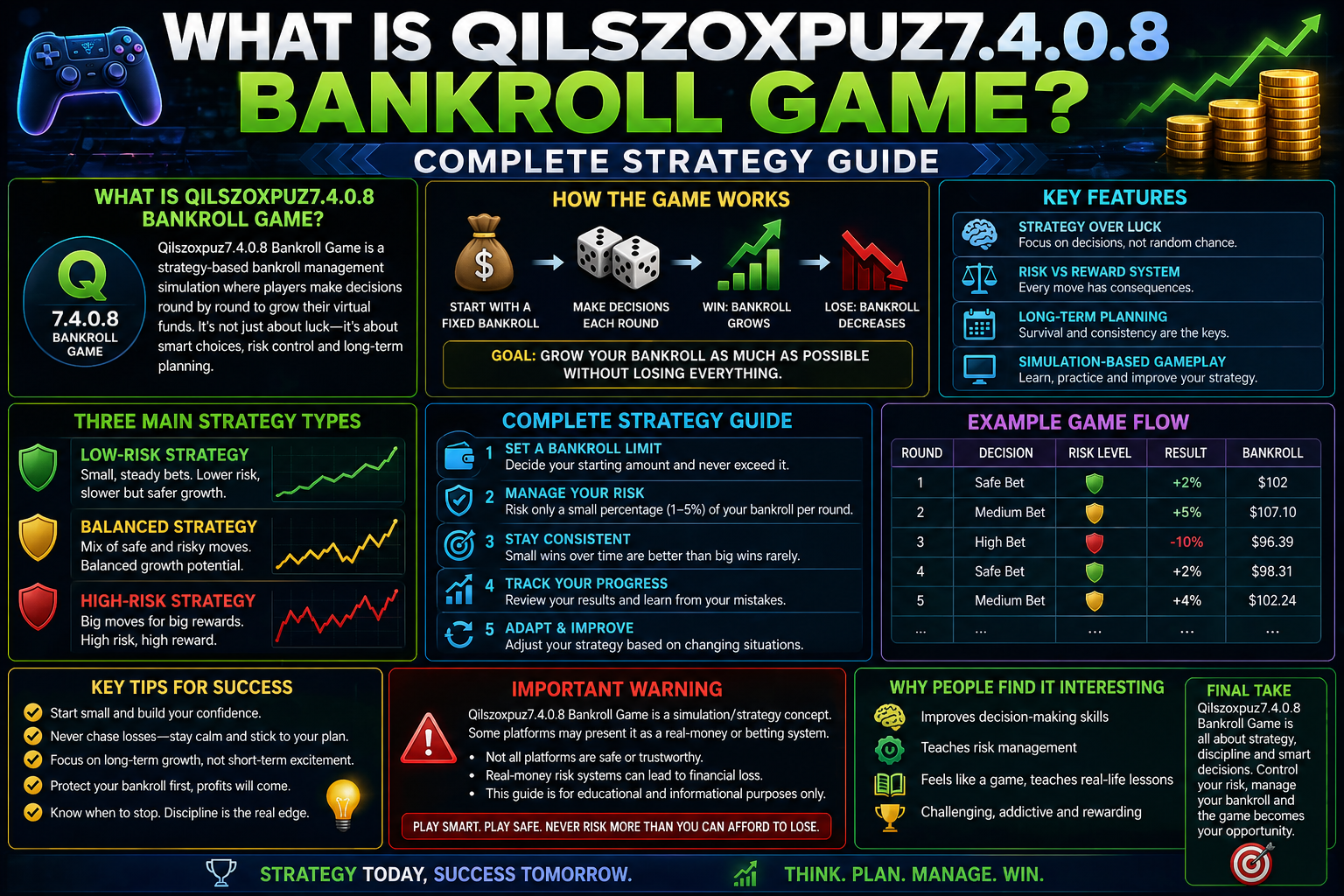
The Qilszoxpuz7.4.0.8 bankroll game is a structured strategy simulation designed to test and improve how you manage limited resources. Instead of relying on luck, it focuses on disciplined decision-making, risk control, and long-term thinking.
In 2026, where financial awareness and smart allocation matter more than ever, this type of simulation is gaining attention among players who want to sharpen real-world skills without risking actual money.
What Is Qilszoxpuz7.4.0.8 Bankroll Game?
At its core, the Qilszoxpuz7.4.0.8 bankroll game is a virtual system where you start with a fixed amount of capital and make calculated decisions to grow it.
Core concept:
- Start with a defined bankroll
- Allocate risk per round
- Adjust strategy based on results
- Aim for steady growth, not quick wins
The “7.4.0.8” typically represents a version or internal build, suggesting a structured and evolving simulation rather than a casual game.
Why This Game Matters in 2026
Modern digital environments demand smarter decision-making. Whether it’s trading, freelancing, or managing income, the same principle applies: control risk or lose everything.
Key relevance:
- Builds financial discipline
- Teaches probability-based thinking
- Improves risk management skills
- Reduces emotional decision-making
This simulation acts as a training ground for real-life financial behavior.
How the Bankroll System Works
Step 1: Set Your Bankroll
Start with a fixed amount (e.g., 1,000–10,000 units).
Define:
- Risk per round (2–5%)
- Session length
- Profit goal
Without these rules, the system fails.
Step 2: Choose Risk Levels
Typical options include:
- Low risk → steady but slow growth
- Medium risk → balanced returns
- High risk → volatile outcomes
Smart players focus on consistency, not excitement.
Step 3: Execute Decisions Carefully
Before confirming any move:
- Review risk percentage
- Understand potential loss
- Stay within limits
A simple pause before action improves long-term results.
Step 4: Review Performance
Every few rounds:
- Check bankroll growth or decline
- Identify patterns
- Adjust strategy
If losing → reduce risk
If winning → scale carefully
Step 5: End with Discipline
Stop when:
- You hit your target
- Session time ends
Track results for improvement:
- Starting balance
- Ending balance
- Key lessons
Key Strategies for Success
1. Stick to Percentage-Based Risk
Never risk large portions of your bankroll at once.
2. Focus on Long-Term Growth
Avoid chasing quick wins. Consistency builds results.
3. Control Emotions
Decisions should be logical, not reactive.
4. Adapt to Changes
If difficulty increases, reduce risk temporarily.
5. Track Every Session
Data improves decision-making over time.
Common Mistakes to Avoid
Chasing losses
Leads to faster depletion of funds.
Ignoring rules
Breaks the entire strategy system.
Overconfidence after wins
Results in unnecessary high-risk moves.
Playing without focus
Reduces accuracy and decision quality.
Real-World Benefits
The skills learned from the Qilszoxpuz7.4.0.8 bankroll game apply beyond the simulation.
Practical applications:
- Personal finance management
- Investment planning
- Business budgeting
- Freelance income control
It trains you to think in percentages rather than emotions.
Future of Bankroll Simulations
In 2026, simulations like this are evolving with:
- AI-driven difficulty adjustment
- Real-time analytics
- Personalized risk models
- Advanced tracking systems
These improvements make them even more valuable as learning tools.
Conclusion
The Qilszoxpuz7.4.0.8 bankroll game is more than a simulation—it’s a practical system for building discipline and improving decision-making.
Success in this game comes from:
- Controlled risk
- Consistent strategy
- Long-term thinking
If used correctly, it becomes a powerful tool that strengthens both in-game performance and real-world financial habits.
FAQs
What is Qilszoxpuz7.4.0.8 bankroll game?
It is a strategic simulation where players manage a fixed bankroll and make calculated decisions to grow it.
Is it based on luck or skill?
It is primarily skill-based, focusing on risk management and decision-making.
Can beginners play this game?
Yes, beginners can start with simple strategies and improve over time.
What is the ideal risk percentage?
Most experts recommend 2–5% per round.
Does it help in real life?
Yes, it improves financial discipline, budgeting, and risk management skills.


