Introduction
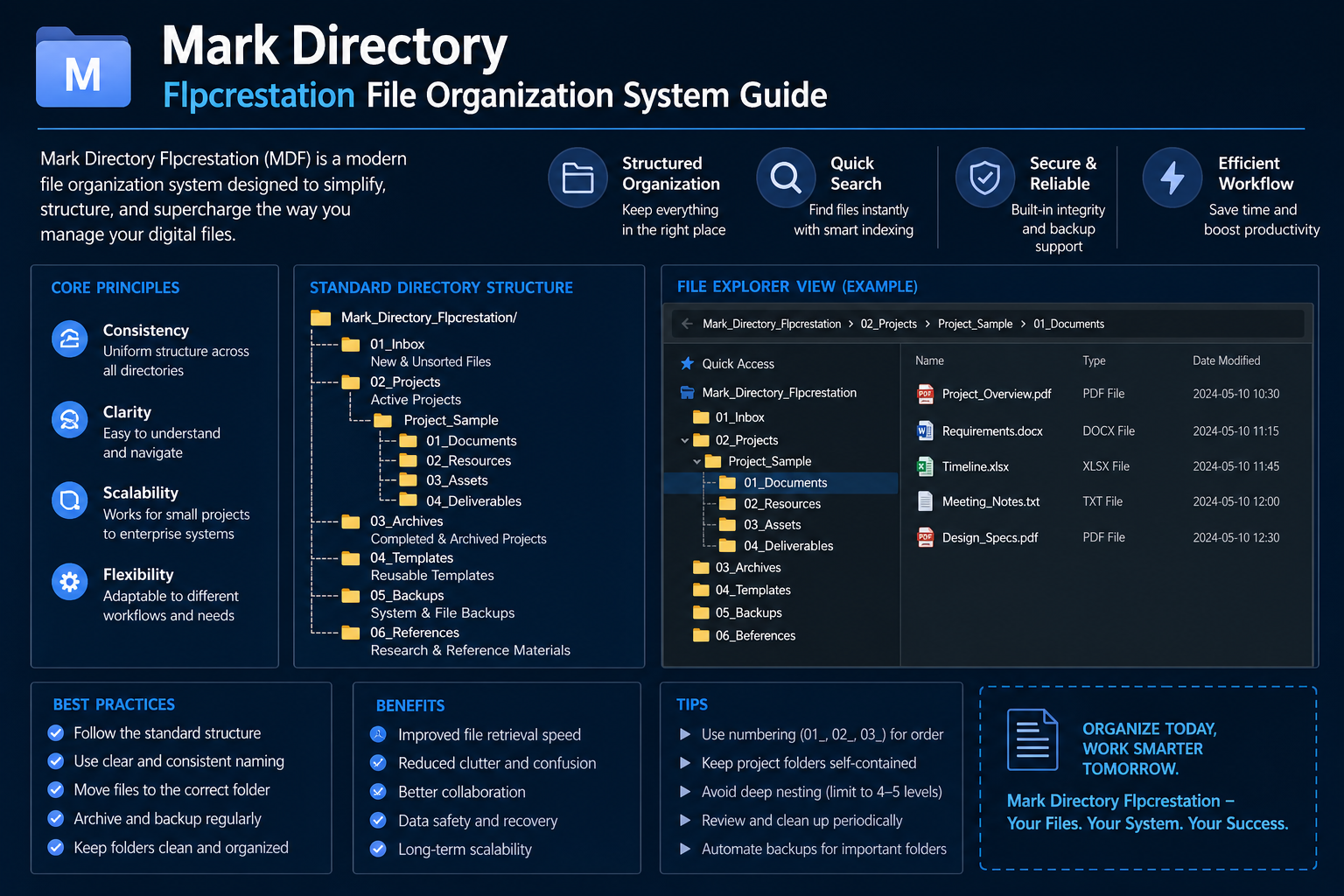
Mark directory flpcrestation is a structured digital file management system designed to simplify how users organize folders, documents, and workflows. In today’s fast-paced digital environment, where thousands of files are created and shared daily, this system helps maintain clarity, speed, and productivity.
Instead of random folder names and scattered data, it introduces a logical structure that makes file access faster and more efficient.
What is Mark Directory Flpcrestation?
Mark directory flpcrestation is a folder organization method where directories are labeled using consistent markers, tags, or prefixes. These markers define the role, status, or category of each folder.
Common structure examples include:
- IN_ for incoming files
- PROC_ for active work
- FINAL_ for completed projects
- ARCH_ for archived data
This system ensures every folder has a clear purpose and lifecycle stage.
Why Mark Directory Flpcrestation Matters
Poor file organization leads to wasted time and reduced productivity. Mark directory flpcrestation solves this by creating predictable and structured file systems.
Key benefits:
- Faster file search and retrieval
- Reduced digital clutter
- Improved team collaboration
- Better workflow tracking
- Consistent file structure across devices
It eliminates confusion caused by random or duplicated folder naming.
How to Set Up Mark Directory Flpcrestation
Step 1: Analyze Your Files
Identify main categories such as:
- Projects
- Clients
- Media files
- Reports
- Archives
Step 2: Create Standard Markers
Use simple and consistent prefixes:
- IN_ (new files)
- PROC_ (in progress)
- FINAL_ (completed work)
- ARCH_ (stored files)
Step 3: Build Folder Templates
Create a master folder structure and reuse it for all new projects.
Step 4: Maintain Consistency
Ensure every file and folder follows the same naming pattern across all devices.
Advanced Usage Techniques
Mark directory flpcrestation can be enhanced with automation tools and metadata tagging.
Advanced improvements:
- Auto file sorting rules
- Cloud sync optimization
- Smart folder tagging
- Backup priority rules
- Search indexing via metadata
These features reduce manual effort and improve workflow speed.
Business and Team Benefits
Organizations benefit significantly from structured file systems.
Use cases:
- Marketing agencies managing campaigns
- Accounting firms organizing financial records
- Developers handling project versions
- Remote teams sharing structured data
Advantages:
- Faster onboarding for new employees
- Reduced file duplication
- Clear version control
- Secure folder permissions
Common Mistakes to Avoid
1. Overcomplicated naming
Too many markers create confusion. Keep it simple.
2. Lack of consistency
Different naming styles break the system.
3. No maintenance
Regular cleanup is essential to keep structure effective.
Real-World Impact
Users who adopt mark directory flpcrestation often experience:
- Faster file access
- Better workflow clarity
- Reduced stress
- Improved team coordination
- More efficient storage usage
It transforms digital chaos into structured order.
Scaling the System
As workload grows, the system can expand across:
- Local storage
- Cloud platforms
- Team drives
- Mobile access tools
It also integrates well with AI-based file management tools and automation systems.
Future of File Organization
Mark directory flpcrestation is designed to remain relevant regardless of changing technology. Its logic-based structure ensures it works across all platforms and future tools.
With regular updates and minor adjustments, it remains a long-term solution for digital organization.
Conclusion
Mark directory flpcrestation is more than just a naming system—it is a complete approach to digital organization. It improves productivity, reduces clutter, and creates a scalable structure for both individuals and teams.
By implementing it correctly, users gain long-term control over their digital workspace and significantly improve workflow efficiency.
FAQs
What is Mark Directory Flpcrestation?
It is a structured file organization system that uses consistent markers to label folders and improve workflow efficiency.
Is it suitable for personal use?
Yes, it works for both personal and professional file management.
Does it improve productivity?
Yes, it reduces time spent searching for files and improves workflow speed.
Can teams use it?
Absolutely, it is highly effective for collaboration and shared drives.
Is it difficult to implement?
No, it can be set up in under an hour with basic folder restructuring.