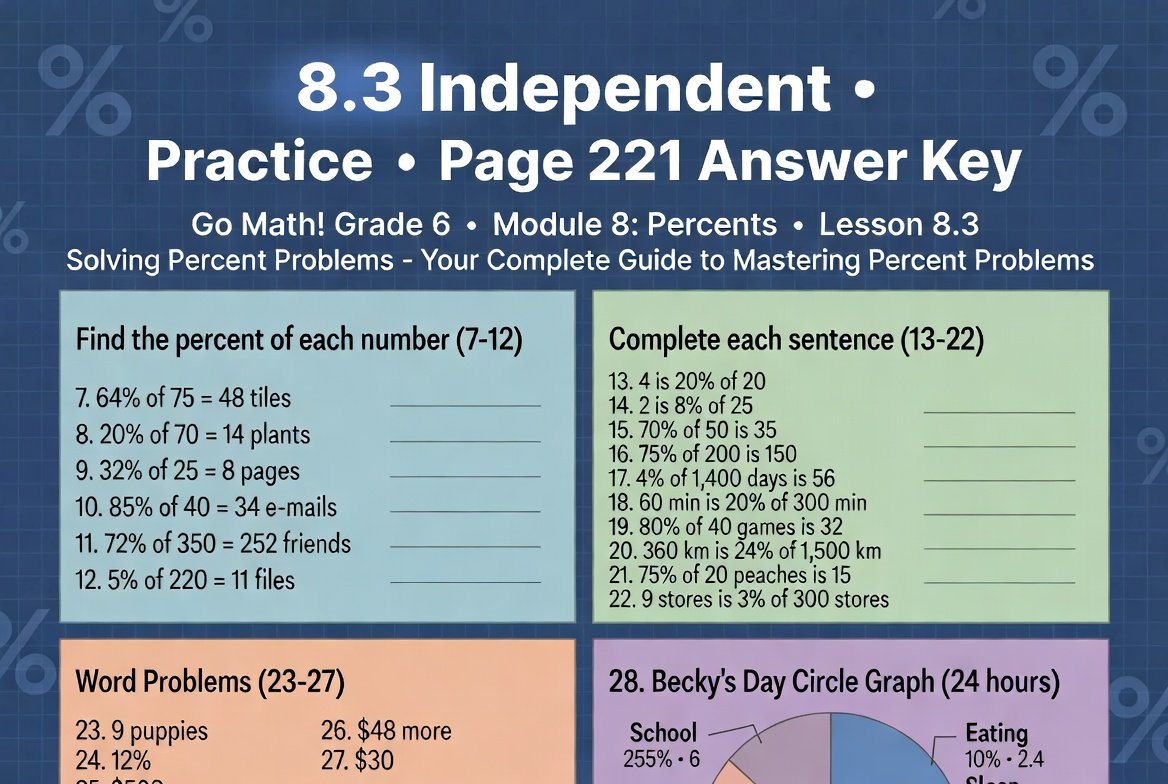
Students searching for reliable help with tricky homework often land on the 8.3 independent practice page 221 answer key.
This resource unlocks the exact solutions and deeper understanding needed for Lesson 8.3 on solving percent problems.
Whether you are stuck on finding the part, the whole, or the percent itself, this guide walks you through every concept with clear explanations, real examples, and practical strategies that build lasting confidence.
Why Percent Problems Matter in Everyday Math
Percentages show up everywhere—from calculating discounts at the store to figuring out tips at a restaurant or understanding interest on a loan.
In middle school math, section 8.3 focuses on using proportions and equations to solve these problems quickly and accurately.
The 8.3 independent practice page 221 answer key helps you check your work while teaching the reasoning behind each step.
Mastering this skill now makes algebra, statistics, and even real-life budgeting much easier later on.
Think about it: if a shirt costs $80 and drops 25 percent during a sale, how much do you actually pay?
Or if you score 45 points out of 60 on a test, what percentage is that?
These are the exact types of questions the 8.3 independent practice page 221 answer key prepares you to handle without hesitation.
Breaking Down the Three Main Types of Percent Problems
Every question in the 8.3 independent practice page 221 answer key falls into one of three categories.
Learning to spot which type you are facing is the first step to solving it fast.
Type 1: Finding the Part You know the whole and the percent, and you need the part. Use the formula: part = (percent/100) × whole.
For example, what is 40% of 250? Convert 40% to 0.40, then multiply: 0.40 × 250 = 100. The part is 100.
This method appears several times in the 8.3 independent practice page 221 answer key because it builds the foundation for more complex word problems.
Type 2: Finding the Percent Here you know the part and the whole, and you solve for the percent.
Set up the proportion part/whole = percent/100, then cross-multiply and divide.
Suppose 36 is what percent of 90? Write 36/90 = p/100. Cross-multiply: 36 × 100 = 90 × p → 3600 = 90p → p = 40.
So 36 is 40% of 90. The 8.3 independent practice page 221 answer key often includes these to strengthen your proportional reasoning.
Type 3: Finding the Whole You know the part and the percent, and you need the whole amount.
Rearrange the equation: whole = part / (percent/100).
If 24 is 30% of some number, write 24 = 0.30 × whole. Divide both sides by 0.30: whole = 24 / 0.30 = 80.
Problems like this test your ability to work backward, a common challenge addressed directly in the 8.3 independent practice page 221 answer key.
Step-by-Step Strategies That Match the 8.3 Independent Practice Page 221 Answer Key
The best way to use the 8.3 independent practice page 221 answer key is not just to copy answers but to understand the process.
Start by reading the problem twice. Underline what you know and circle what you need to find.
Next, choose your tool — proportion or equation — based on the type you identified.
Draw a quick model if the problem involves a real-world situation. A bar diagram or a 10-by-10 grid helps visualize percents.
Then set up the math carefully. Always check your answer by plugging it back into the original problem. Does it make sense?
For instance, if the question asks for a percent higher than 100, double-check your setup because that usually signals a mistake in identifying the whole.
When working through the 8.3 independent practice page 221 answer key, label every step: “percent to decimal,” “cross-multiply,” “divide both sides.”
This habit turns messy problems into clean, logical solutions and reduces careless errors by half.
Common Mistakes Students Make—and How to Avoid Them
Even strong students trip over the same issues when tackling the 8.3 independent practice page 221 answer key.
One frequent error is forgetting to convert the percent to a decimal or fraction before multiplying.
Another is mixing up the part and the whole in the proportion setup. Always ask: “Is this the piece I’m looking for, or the total amount?”
Word problems can trick you with extra numbers that are not needed. Train yourself to ignore irrelevant details.
Also, watch for problems that ask for the percent of increase or decrease — these require subtracting the original amount first.
The 8.3 independent practice page 221 answer key highlights these patterns so you learn to spot them instantly.
Practice estimating first. If 20% of 400 should be around 80, any answer far from that tells you to recheck your work.
Estimation acts as a safety net that builds both speed and accuracy.
Real-World Applications That Bring the Concepts Alive
The skills in the 8.3 independent practice page 221 answer key extend far beyond the textbook.
Imagine running a small business: you need to calculate a 15% tip for your staff or apply a 12% sales tax to customer orders.
Budgeting your allowance? Figuring out how much you save with a 30% discount teaches financial responsibility early.
In sports, percentages measure free-throw success or batting averages. In science, they describe concentrations in solutions.
Even video games use percent progress bars. Seeing these connections makes the 8.3 independent practice page 221 answer key feel less like homework and more like a useful life tool.
Extra Practice Examples to Reinforce Your Learning
Try these similar problems that mirror the style found throughout the 8.3 independent practice page 221 answer key:
- A phone plan costs $60 per month. If you get a 25% discount for paying yearly, how much do you save each month?
- 72 students attended a school event. This represents 40% of the total student body. How many students are in the school?
- A book costs $45 after a 10% discount. What was the original price?
Work each one using the strategies above, then compare your steps to the reasoning style in the 8.3 independent practice page 221 answer key.
The more you practice independently, the faster you will solve them on tests.
Advanced Tips for Faster, Smarter Solutions
Once you feel comfortable with the basics, level up. Learn to solve percent problems mentally for simple cases: 10% of any number is just moving the decimal one place left. 50% is half. 25% is one-fourth. These shortcuts save time during the independent practice.
You can also use the percent proportion in one equation for all three types: part/whole = percent/100.
This single setup works universally and appears repeatedly in the 8.3 independent practice page 221 answer key.
For repeated practice, create your own word problems using prices from your favorite store or scores from recent games.
Teaching the method to a friend or family member solidifies your own understanding.
Building Long-Term Confidence with Consistent Practice
The 8.3 independent practice page 221 answer key is not a shortcut to avoid learning — it is a mirror that shows exactly where your thinking is strong and where it needs polishing.
Review one or two problems daily. Track your speed and accuracy over a week. You will notice improvement almost immediately.
Remember, math builds like a tower. Solid percent skills support future topics such as ratios, probability, and even basic algebra.
Investing time now in the 8.3 independent practice page 221 answer key pays off for years.
Conclusion: Turn Confusion into Mastery
The 8.3 independent practice page 221 answer key exists to guide you toward real understanding rather than rote memorization.
By focusing on the three problem types, using clear step-by-step setups, avoiding common pitfalls, and connecting math to real life, you transform challenging homework into an opportunity for growth.
Keep practicing, stay curious, and watch your confidence soar. Every correct solution brings you closer to becoming the kind of problem-solver who handles percentages effortlessly in school and beyond.